
Vision therapy is a personalized program that helps improve visual skills that glasses or contact lenses cannot correct on their own. It may be recommended for children or adults with eye teaming, tracking, focusing, alignment, or visual-processing challenges that affect reading, school, sports, work, or daily activities.
It starts with a visual skills assessment
A standard eye exam checks how clearly you see and evaluates eye health. A vision therapy assessment takes a closer look at how the eyes work together and how visual information is processed.
Depending on the patient’s concerns, the assessment may evaluate:
- Eye alignment and movement
- Eye teaming and depth perception
- Tracking across a page or moving target
- Focusing ability between near and far distances
- Visual attention and processing
- How vision works with balance, movement, and coordination
This information helps identify whether a challenge is related to the prescription itself or to visual skills that may need additional support.
Tools your vision therapy program may include
Every program is different, but therapy sessions often use hands-on tools and guided activities to build visual skills over time.
Brock string
A Brock string is a simple tool with colored beads placed along a string. It can help assess and train eye teaming, convergence, and awareness of how both eyes are working together.
It may be useful for patients who experience double vision, eye strain, or difficulty maintaining clear, comfortable vision up close.
Red-green lenses and anti-suppression activities
Special red-green lenses and matching activities can encourage both eyes to participate in a task. These tools may be used when one eye is doing more of the work or when the brain suppresses input from one eye.
They can support treatment for some binocular vision concerns, including amblyopia and eye coordination difficulties.
Prisms and lens activities
Prisms may be used during assessment or therapy to challenge eye alignment, spatial awareness, and visual coordination. Lens activities can help build focusing skills, including the ability to shift focus between a book, screen, desk, and distant target.
These skills can be especially important for patients who experience headaches, blurry vision, or fatigue after prolonged reading.
Tracking and visual-processing activities
Some activities are designed to improve how the eyes follow words across a page, locate visual information, or move accurately from one target to another. For a child who loses their place while reading or struggles to copy from the board, these skills can matter just as much as seeing the letters clearly.
Marsden ball activities
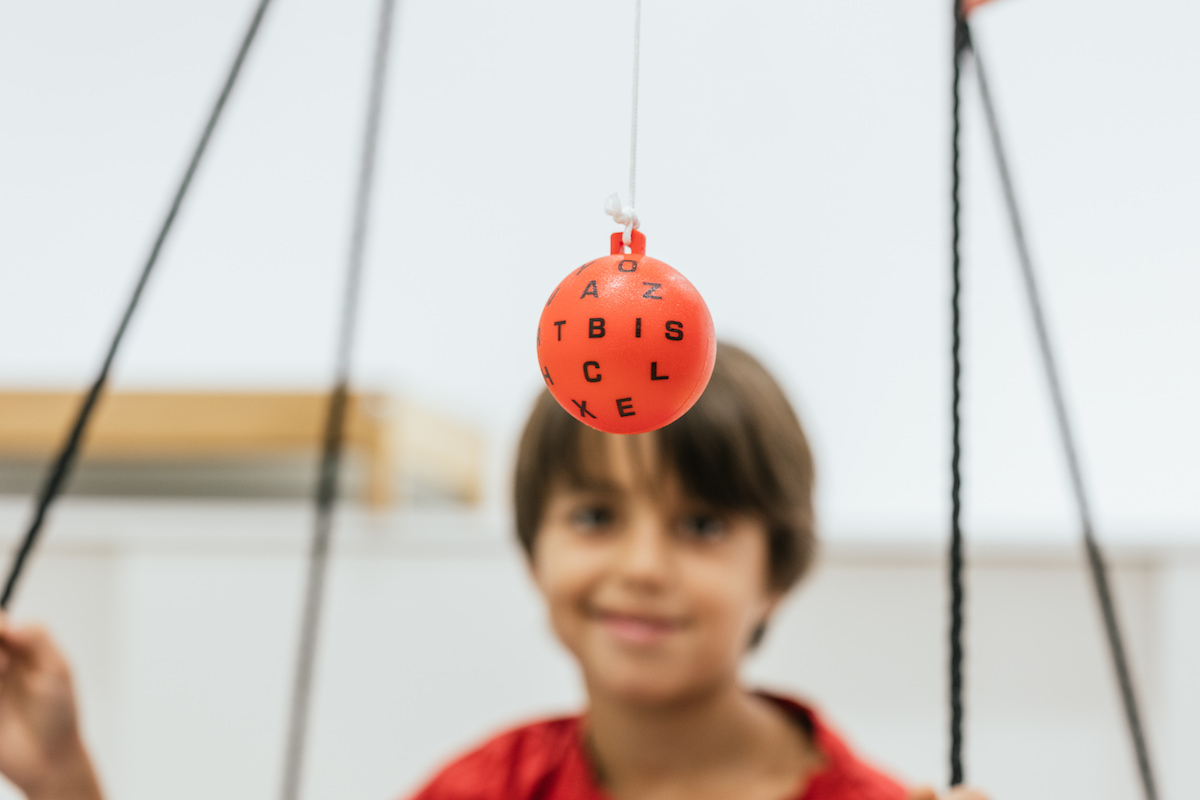
A Marsden ball is a suspended ball marked with letters, numbers, or symbols. Following it as it moves can help build tracking, visual attention, and eye-hand coordination.
It may be used for patients whose visual challenges affect reading, sports, or everyday movement.
Balance boards and movement-based activities
Vision is closely connected to balance, posture, and movement. Interactive activities using balance boards, exercise balls, and other hands-on tools can help patients practice visual skills in a more active setting.
This approach can be helpful for patients whose concerns affect sports, coordination, or everyday movement.
Your program should fit your goals
A child struggling to focus in school may need a different plan than an adult with headaches, double vision, or visual symptoms after a concussion. Therapy activities are adjusted as skills improve and goals change.
The purpose is not simply to complete exercises. It is to strengthen the visual skills needed for more comfortable, effective performance in the activities that matter to you.